• Home
    • Soap
    • Tallow Balm
    • Gift Card
    • Subscriptions
  • Testimonials
  • Where to Find Us
    • About Us
    • Our Mission
  • Blog
  • Contact
  • Sign In My Account
Menu

The Healthy Porcupine

PO BOX 1042
Concord, NH 03302
Phone Number
The Healthy Porcupine® - Opt Out of the Chemical Lifestyle™

The Healthy Porcupine

  • Home
  • Shop
    • Soap
    • Tallow Balm
    • Gift Card
    • Subscriptions
  • Testimonials
  • Where to Find Us
  • About
    • About Us
    • Our Mission
  • Blog
  • Contact
  • Sign In My Account

Tallow Balm vs. Shea Butter: Which one is right for your skin? 

October 15, 2026 Tiffany Rinehart

If you have spent any time in the natural skincare world, you have probably encountered both tallow balm and shea butter as moisturizer alternatives to conventional lotion. Both are natural and are free of the synthetic preservatives and fillers found in most drugstore products. They also have loyal followings and are often recommended for dry, sensitive, or compromised skin.

So, which one is actually better?

The honest answer is it depends on your skin and what you are looking for. But the comparison between the two is worth making carefully, because they are fundamentally different kinds of ingredients. One is animal-based, and one is plant-based, but both have different compositions, textures, and strengths. Here is what you actually need to know.

What is tallow balm?

Tallow is rendered beef fat, specifically, the fat from grass-fed cattle that has been slowly melted down, purified, and cooled into a stable, nutrient-dense ingredient. Tallow balm is simply tallow in a form designed for skincare, often combined with a small amount of complementary oil to adjust texture and absorption.

Our tallow balm is made with two ingredients: grass-fed tallow sourced from New England farms and high oleic unrefined sunflower oil. No water, no preservatives, no fillers.

What is shea butter?

Shea butter is a plant-based fat extracted from the nuts of the shea tree, native to sub-Saharan Africa. People have used it in skincare and cooking for centuries, and it remains one of the world's most widely used natural moisturizing ingredients. It is solid at room temperature, melts on contact with skin, and has a mild, slightly nutty scent in its unrefined form.

How do the ingredients compare?

This is where the comparison gets interesting.

Fatty acid profile:

Both tallow and shea butter are rich in oleic acid, stearic acid, and palmitic acid, the primary fatty acids associated with skin nourishment and barrier support. The key difference is in the ratio and origin of those fats.

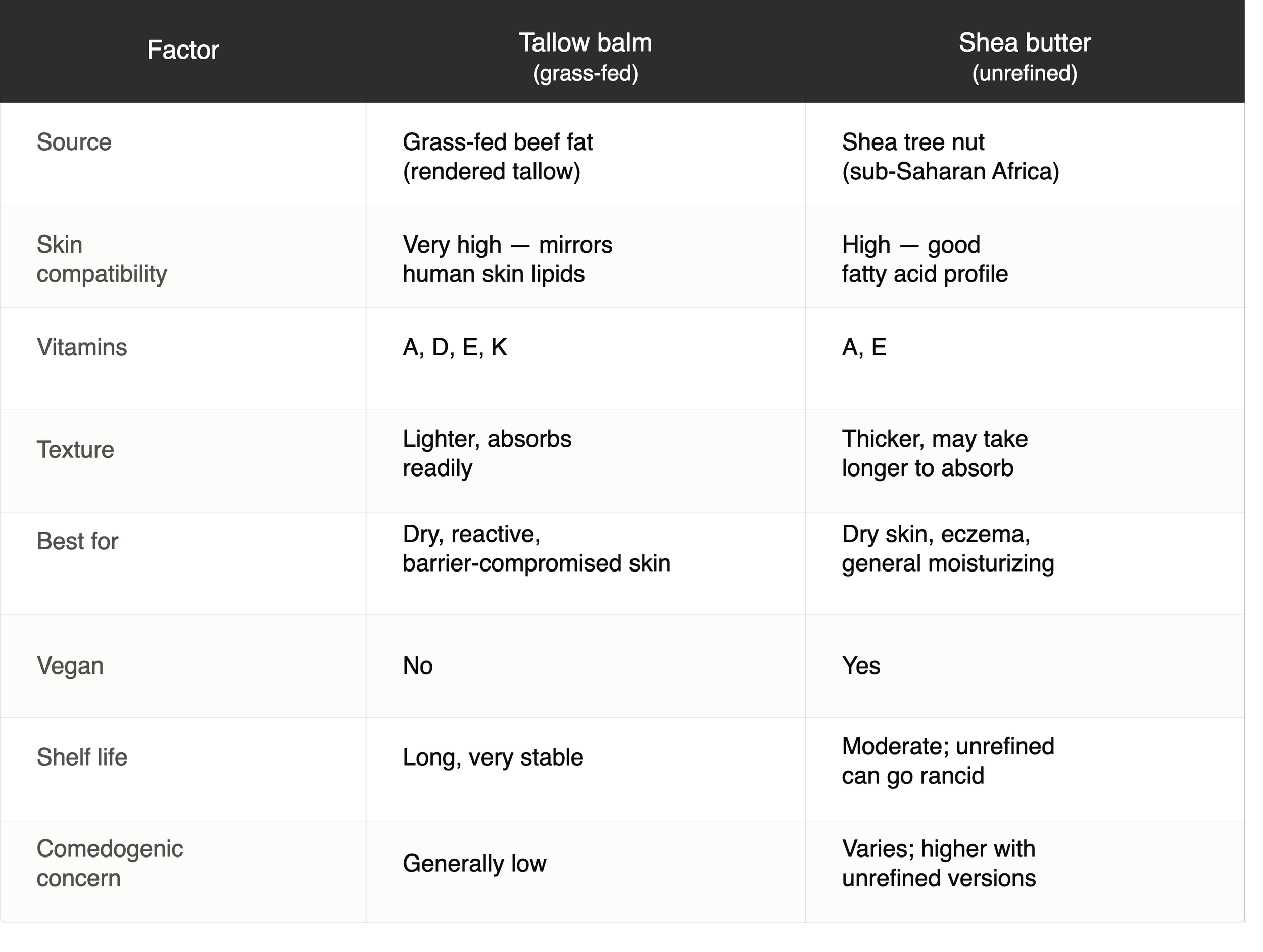
Tallow's fatty acid profile is often described as one of the closest natural matches to the lipids found in human skin, specifically in the stratum corneum, the outermost layer of the skin barrier. Because of this similarity, tallow is absorbed readily and recognized by the skin in a way that many plant-based alternatives are not. Shea butter's fatty acid profile is similar in some respects but comes from a plant source, which means its lipid structure differs from human skin in ways that affect absorption and bioavailability.

Vitamins and nutrients:

Both tallow and shea butter contain fat-soluble vitamins. Tallow from grass-fed animals is rich in vitamins A, D, E, and K, the same vitamins that support skin cell renewal, barrier repair, and protection from oxidative damage. Shea butter contains vitamins A and E, as well as antioxidant phenolic compounds and triterpenes with anti-inflammatory properties. Grass-fed tallow has a higher concentration of these fat-soluble vitamins than conventionally raised tallow, which is one reason sourcing matters.

Texture and absorption:

This is one of the most commonly noted differences between the two. Tallow balm is lighter and more readily absorbed than shea butter, which tends to be thicker and can feel heavier on the skin, particularly in warm weather. Tallow melts easily at body temperature and absorbs without a greasy residue when applied in a small amount to damp skin. Shea butter, especially unrefined, can leave more of a film and may take longer to absorb.

Comedogenic potential:

Shea butter's comedogenic rating is a topic of some debate. Sources vary, and comedogenicity is highly individual; what clogs one person's pores may be perfectly fine for another. That said, unrefined shea butter, with its higher concentration of natural components, is generally considered more likely to cause issues for acne-prone skin than refined shea butter. Tallow, despite being an animal fat, is generally well tolerated by acne-prone skin and is considered non-comedogenic by most who use it regularly. However, as with any ingredient, individual results vary.

Where shea butter has the edge

Shea butter is plant-based, which makes it accessible to people who avoid animal products for ethical or dietary reasons. It is also widely available, comes in a range of price points, and has a long track record in mainstream skincare. Unrefined shea butter retains more of its natural nutrients than refined, and its anti-inflammatory triterpenes make it a genuinely useful ingredient for dry and eczema-prone skin. It is also a good option for people with tree nut allergies who cannot tolerate certain plant oils, although shea itself is a tree nut, so those with nut allergies should check with a physician before use.

Where tallow balm has the edge

The primary argument for tallow over shea butter comes down to biocompatibility. Because tallow's composition closely mirrors the lipids found in healthy human skin, it absorbs more efficiently. It provides the skin with building blocks it can use rather than simply coating the surface.

For people with very dry, compromised, or reactive skin, including those dealing with eczema, psoriasis, or chronic dryness, tallow tends to produce more noticeable results than shea butter, which is why it has become a go-to in the natural skincare community for these concerns. It also contains the full complement of fat-soluble vitamins A, D, E, and K in a form the skin can utilize directly, whereas shea butter offers A and E but not D or K.

Tallow balm also has a longer shelf life than unrefined shea butter, which can go rancid if not stored properly. And because tallow balm contains no water, it requires no preservatives to stay stable, keeping the ingredient list as short as possible.
What about people who avoid animal products?

This is a real consideration and worth addressing directly. Tallow is an animal-derived ingredient, and for people who follow a vegan or plant-based lifestyle, it is simply not an option regardless of its skincare properties. Shea butter is the more appropriate choice in that case, and it is a genuinely good ingredient. The comparison here isn't about one being acceptable and the other not; it is about helping people open to both options understand the real differences.

Overall, both tallow balm and shea butter are solid natural alternatives to conventional lotion. Both are free of synthetic preservatives and far cleaner than most mainstream moisturizers. The choice between them comes down to a few key factors:

If you have been using shea butter and it works well for your skin, there is no reason to stop. But if you have tried it and found it too heavy, not absorbing well, or not making the difference you were hoping for, then tallow balm is a logical next step, and one that many people find outperforms every plant-based moisturizer they have tried.
Tags tallow, Tallow Balm, tallow soap guide, shea butter, moisturizer
Comment

Which Healthy Porcupine soap is right for you? A Quick Guide

June 9, 2026 Tiffany Rinehart

With so many soaps to choose from—seventeen bars and counting—we hear one question more than almost any other: "Which one should I start with?"

It's a great question. And the honest answer is: it depends. Not on a complicated quiz or a ten-step skincare analysis, but on two simple things: what your skin needs and what experience you're looking for in the shower.

Every bar we make starts with the same foundation: grass-fed tallow sourced from local farms, cold-processed the traditional way. That means every soap on this list cleanses gently, lathers richly, and leaves your skin feeling nourished rather than stripped. What changes from bar to bar is the added ingredients, such as essential oils or other specialty additives like coffee, pumice, and zinc, which makes each bar suited to a slightly different person or purpose.

Here's a simple way to find yours.

If you have sensitive skin or want to start simple: Pure tallow soap (Unscented)

This is our most popular bar for a reason. No fragrance, no extras, just saponified grass-fed tallow. If you've struggled with soaps that irritate your skin, dry you out, or trigger reactions, this is where to begin. It's also the bar we reach for most often at the handwashing sink. Sometimes the simplest thing is the right thing.

Good for: sensitive skin, fragrance sensitivities, multiple chemical sensitivities, babies and children, and anyone who wants a no-fuss daily bar.

If your skin needs extra calming support: Zinc tallow soap

Our newest bar, and one we're proud of. This is our Pure tallow soap with the addition of 2% zinc oxide, an ingredient long valued for its ability to soothe irritation, help balance oil, and support a more comfortable cleanse for reactive skin. If you find that even gentle soaps leave your skin feeling off, or if you're dealing with redness, breakouts, or that frustrating combination of oily and sensitive at the same time, this bar was made with you in mind.

Good for: acne-prone skin, oily or combination skin, redness-prone skin, and anyone whose skin feels easily irritated.

If you deal with eczema, psoriasis, dry skin, or rashes: Pine Tar 20% tallow soap

Pine tar has been used in skincare for centuries, and there's a reason it has never gone away. Our pine tar soap contains 20% kiln-burned pine tar from Sweden—the highest grade available, made the traditional way by burning pine stumps in kilns. That 20% concentration is intentional: we want you to actually feel the benefit, not just have it listed as a trace ingredient. Customers with eczema, psoriasis, rosacea, poison ivy reactions, and stubborn dry skin reach for this bar again and again. It has a distinctive, earthy, campfire-like scent that many people come to love.

Good for: eczema, psoriasis, dry or itchy skin, rashes, and anyone seeking the deep-cleansing and anti-inflammatory properties of traditional pine tar.

If you want a workhorse bar for dirty hands: Pumice tallow soap

Gardeners, mechanics, woodworkers, painters—this one's for you. Ground pumice gives this bar a gentle but effective scrubbing action that lifts grease, grime, paint, and sap without the harsh chemicals found in most industrial hand soaps. It's unscented and tough enough for a full day's work, but because it's still a tallow base, it won't leave your hands cracked and dry. Keep it in the garage, the garden shed, or by the kitchen sink.

Good for: working hands, outdoor workers, anyone who needs a deeper clean without drying ingredients.

If you want to energize your morning: Eucalyptus or Eucalyptus and Peppermint tallow soaps

These two bars are our go-to recommendation for people who want their shower to feel like a reset. Eucalyptus is cool, clean, and clarifying. Add peppermint to the mix, and it becomes even more invigorating, the kind of bar that wakes you up faster than your first cup of coffee. Both are popular choices for body and face wash alike.

Good for: morning showers, mental clarity, and skin that benefits from antibacterial and anti-inflammatory essential oils.

If you want to wind down at night: Lavender or Lavender and Spearmint tallow soaps

Lavender is a classic for good reason; it's soothing, antioxidant-rich, and genuinely calming. Our Lavender tallow soap is soft and floral. When you add spearmint, it becomes something a little more interesting: still relaxing, but with a fresh, uplifting brightness that keeps it from feeling heavy. One of Jen's personal favorites, for what it's worth.

Good for: evening routines, sensitive or irritated skin, and anyone who wants their shower to be a moment of calm.

If you want something fresh and citrusy: Lemongrass, Lemon Lime, or Rosemary Mint tallow soaps

These three are the bright, clean options in the lineup. Lemongrass is earthy and citrusy with natural antibacterial properties—a great everyday bar. Lemon Lime is light and uplifting, high in antioxidant vitamin C. Rosemary Mint is herbal and fresh, with a clean scent that works as well in the morning as it does after a workout. All three make excellent hand soaps to keep by the kitchen sink, too.

Good for: everyday use, oily or acne-prone skin, post-workout showers, and anyone who prefers a clean, fresh scent.

If you want something warm and grounding: Cedarwood, Orange Clove, or Patchouli tallow soaps

Our second-biggest seller, Orange Clove, is spicy, warm, and cozy, and our customers tell us it smells like the holidays in a bar. Cedarwood is woodsy and earthy, great for people who like a more grounded, rich scent. Patchouli is rich and distinctive, with naturally regenerative and cell-renewing properties. All three are popular as gifts and as personal favorites for people who want their bar to feel a little more luxurious.

Good for: cooler months, gifting, and anyone who prefers warm, earthy, or spiced scents.

If you want targeted skin support from your essential oils: Tea Tree, Lavender and Tea Tree, or Coffee! tallow soaps

Tea Tree is widely known for its antibacterial and antifungal properties, and it's a popular choice for acne-prone skin and for people who want a cleanser that does a little more. Lavender and Tea Tree pairs those cleansing qualities with the calming benefits of lavender, making it one of our most versatile bars. And Coffee!, our exfoliating bar made with real coffee grounds, is a favorite for people who want a gentle morning scrub. It's also one of the best bars to keep by the kitchen sink to neutralize stubborn odors from garlic, onion, or fish.

Good for: acne-prone skin, oily skin, exfoliation, and kitchen hand-washing.

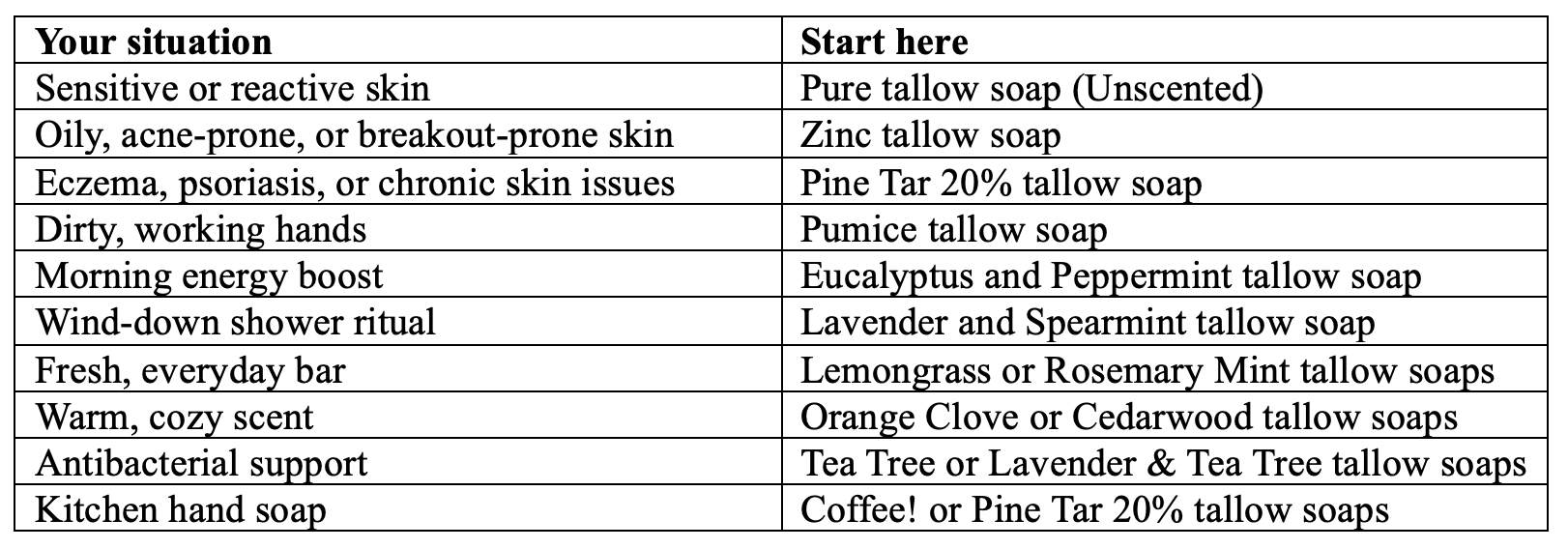
Still not sure? Here's the short version:

The good news is that because all of our soaps start with the same tallow base, there's no wrong choice. They all cleanse gently, last longer than conventional soap, and leave your skin feeling clean and conditioned rather than stripped. The scent and specialty ingredient are really just about finding what feels right for you.

Tags tallow, tallow soap, tallow soap guide, Tallow Balm, Tallow soapmaking, Tallow Soap, grass-fed tallow soap, Essential Oil Soap, essential oil, Healthy Lifestyle
Comment
No results found
nhmade

HANDMADE WITH CARE IN NEW HAMPSHIRE.

images and text copyright
© 2026 The Healthy Porcupine
All rights reserved

 *These statements have not been evaluated by the Food and Drug Administration. This product is not intended to diagnose, treat, cure, or prevent any disease.